On this page
- What a hook is, and what TikTok itself says
- Roman Urdu, Urdu script or English: how to choose
- 7 TikTok hook types with Urdu and Roman Urdu examples
- The payoff rule: every hook is a promise
- One idea, three hooks: a worked example
- Common hook mistakes, and the fix
- How to test your hooks without guessing
- Where to find hooks that already worked in your niche
- FAQ
Quick answer: A TikTok hook in Urdu is the first one to three seconds of your video: the line you say, the words on screen and the first thing viewers see. Write the on-screen text in the script your commenters use, Roman Urdu or Urdu, keep it to about 5 to 10 words, and name one specific question, mistake, number or price. Pay it off within seconds, then test hook types against your own median views.
Urdu hooks work like English ones, but almost every guide online gives only English examples. Below are 7 hook types with 35 examples in both scripts, a way to choose your script, and a simple test to see which hook works on your account.
All 35 lines are templates we wrote for this guide, not quotes from real videos. Swap in your own niche, number and city.
What a hook is, and what TikTok itself says
TikTok does not publish a "hook score". What it does publish is how it measures attention. In its Creator Academy guide to analytics (updated 14 Oct 2026), TikTok lists three numbers to watch for every video:
- Retention rate: the percentage of your video that viewers watched. TikTok tells creators to find the drop-off points and check what was on screen at that moment.
- Average watch time: how long viewers stayed, on average.
- Watched full video: the share of viewers who reached the last few seconds.
The hook decides the first part of that retention curve. If most people leave in the first two seconds, nothing after it gets seen.
TikTok's own explainer on how the For You feed recommends videos (June 2020, still the clearest official description) says a strong signal is whether a viewer finishes a longer video, while your language preference and country setting get lower weight. In plain words: speaking Urdu does not hurt you or help you by itself. Holding the viewer does.
For paid ads, TikTok's creative best practices say to put the hook in the first 6 seconds and the main idea in the first 3. That page is written for advertisers, not creators, but the logic carries over: say what the video is about before the viewer's thumb moves.
Roman Urdu, Urdu script or English: how to choose
Pakistan is a big TikTok audience. DataReportal's Digital 2026 Pakistan report says TikTok had 79.9 million users aged 18 and above in Pakistan in late 2025. They do not all read the same script, so the choice matters for your on-screen text.
Use this rule: write your on-screen hook in the script your commenters use.
- Open your last 10 videos and read the comments.
- If most comments are in Roman Urdu ("bhai kamaal", "yeh kahan se liya"), use Roman Urdu on screen.
- If most are in Urdu script, use Urdu script. Pick a clear, bold Urdu font and give it a little more screen time, because Nastaliq is harder to read at small sizes.
- If your viewers mix in English words, you can too. "Budget phone ki 3 galtiyan" reads faster than a fully formal sentence.
Two practical points:
- Spoken and written can differ. Many Pakistani creators speak Urdu but put Roman Urdu text on screen. That is fine, as long as both say the same idea in the first second.
- Keep it short. A six-word hook on screen for one to two seconds is about right (see the FAQ on length).
7 TikTok hook types with Urdu and Roman Urdu examples
Each type has four Roman Urdu lines and one in Urdu script. The types match the ones most English guides use, so you can borrow ideas from both.
1. Question hook (Sawal)
Ask the question your viewer already has in their head. It works best when the answer is specific and comes fast.
- "Biryani mein aloo kyun daala jata hai? Asal wajah suno."
- "Kya aapka phone bhi raat ko garam hota hai?"
- "Matric ke baad kaunsa group? Pehle yeh 3 sawal poochein."
- "Lawn ka suit 3 dhulai mein rang kyun chhorta hai?"
- Urdu: "کیا آپ کا فون بھی رات کو گرم ہوتا ہے؟"
2. Warning hook (Galti)
A warning promises to save the viewer from a loss. Name the mistake exactly, not "a big mistake".
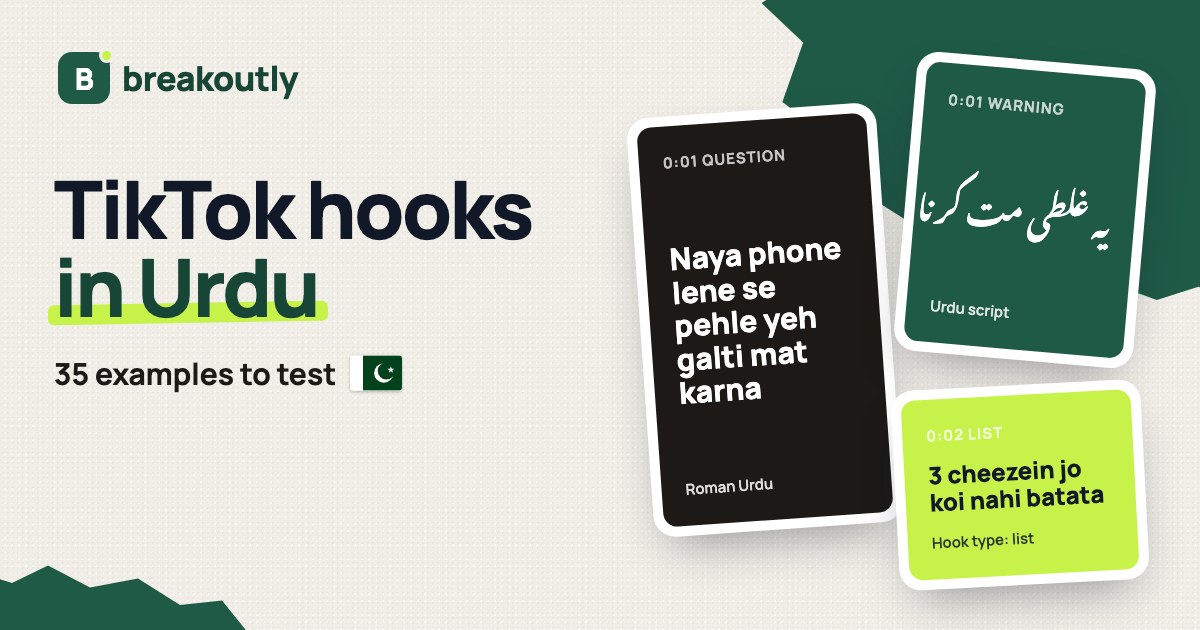
- "Naya phone lene se pehle yeh galti mat karna."
- "Chehre pe nimbu kabhi nahi lagana. Wajah 20 second mein."
- "Fiverr pe pehla gig banate waqt yeh line likhna band karo."
- "Chai mein doodh pehle daalte ho? Ruko."
- Urdu: "نیا فون لینے سے پہلے یہ غلطی مت کرنا۔"
3. List hook (Cheezein, tareeqe)
A number tells the viewer how long the video will take and gives them a reason to stay to the last item.
- "3 cheezein jo har naye freelancer ko pehle din seekhni chahiye."
- "Bijli ka bill kam karne ke 5 tareeqe, number 4 sab bhoolte hain."
- "Lahore mein 500 rupay se kam ke 3 nashte."
- "Exam se pehle raat ko 4 kaam, aur 1 jo kabhi nahi karna."
- Urdu: "تین چیزیں جو ہر نئے فری لانسر کو پہلے دن سیکھنی چاہئیں۔"
4. Story hook (Maine, mera)
Start in the middle of something that happened to you. The viewer stays to see how it ends.
- "Mera pehla client Dubai se aaya, aur galti meri thi."
- "Pichli Eid pe ammi ne yeh trick sikhayi, ab har baar yahi karti hoon."
- "Meri dukaan ka sab se zyada bikne wala item sab se sasta nikla."
- "Maine 3 mahine roz ek video daali. Yeh hua."
- Urdu: "میرا پہلا کلائنٹ دبئی سے آیا، اور غلطی میری تھی۔"
5. Challenge hook (Din, hafta)
A challenge creates a series. Day 1 hooks pull viewers into Day 2, so put the day number on screen.
- "7 din sirf ghar ka khana, kharcha kitna aaya?"
- "30 din roz 20 minute English bolne ki koshish. Day 1."
- "1,000 rupay mein poora hafta school lunch. Day 1."
- "Maine 10 din phone raat 9 baje band kiya."
- Urdu: "سات دن صرف گھر کا کھانا، خرچہ کتنا آیا؟"
6. Price reveal hook (Kitne ka?)
Prices are one of the first things Pakistani viewers ask in the comments. Put the price in the hook and answer the question before it is asked. Keep it to the price of a product or a setup, never income claims.
- "Yeh poora desk setup 12,000 rupay ka hai. Breakdown dekho."
- "Anarkali mein yeh jhumke 350 ke, online 1,200 ke."
- "200 wala charger vs 2,000 wala: farq dekho."
- "Mehndi ka poora stage, har cheez ki qeemat screen pe."
- Urdu: "یہ پورا سیٹ اپ بارہ ہزار روپے کا ہے۔ تفصیل دیکھیں۔"
7. Curiosity gap hook (Raaz, wajah)
Open a gap the viewer wants closed. This is the strongest type and the easiest to abuse, so read the payoff rule below.
- "Yeh baat koi electrician nahi batata."
- "Darzi aap se yeh kabhi nahi kahega."
- "Is ek wajah se aapki roti nahi phoolti."
- "Airport pe ek counter hamesha khaali hota hai. Yeh hai wajah."
- Urdu: "یہ راز کوئی الیکٹریشن نہیں بتاتا۔"
The payoff rule: every hook is a promise
A hook that the video does not deliver gets people to stay for two seconds and then leave angry. That shows up as a sharp drop in your retention graph, which is exactly the signal TikTok says it weighs. So check every hook against its payoff before you post.
| Hook | Weak payoff | Strong payoff |
|---|---|---|
| "Naya phone lene se pehle yeh galti mat karna." | Talks about phones in general for 40 seconds | Names the mistake (checking only the RAM) in second 3, then shows why |
| "Lahore mein 500 rupay se kam ke 3 nashte." | Two of the three cost more than 500 | Three places, three prices on screen, one location tag each |
| "Yeh baat koi electrician nahi batata." | A tip everyone already knows | A specific check the viewer can do at home today |
A simple test: if a friend watched only the first 5 seconds, would they know what the video gives them? If not, move the payoff earlier.
One idea, three hooks: a worked example
Illustrative example, written for this guide.
One idea, a lower summer electricity bill, opened three ways:
| Hook type | Spoken line (first 2 seconds) | On-screen text | First frame |
|---|---|---|---|
| Question | "Garmiyon mein bill 20,000 se upar kyun jata hai?" | Bill 20,000+ kyun? | Your hand holding last month's bill |
| Warning | "AC chalate waqt yeh galti mat karna." | AC ki 1 galti | AC remote, thermostat on screen |
| List | "Bijli ka bill kam karne ke 3 tareeqe." | 3 tareeqe, bill kam | Three fingers up, bill in the other hand |
In each row the spoken line and the text say the same idea, so a viewer with the sound off still gets it, and the first frame shows the topic before a word is read. Post them as three separate videos with different examples, never one video uploaded three times.
Common hook mistakes, and the fix
| Mistake | Why it hurts | Fix |
|---|---|---|
| Opening with "Assalam o alaikum dosto, aaj ki video mein..." | The first seconds carry no reason to stay | Greet after the hook, or skip it |
| A full sentence of Nastaliq in small type | Hard to read in one second | Five or six words, large and bold |
| A shocking hook the video never pays off | Viewers leave early, which shows up in your retention graph | Use the payoff table above before you post |
How to test your hooks without guessing
Most guides stop at "test and iterate". Here is a method you can run in two weeks with nothing but TikTok Studio.
- Pick one format you already post, for example a 30 to 45 second tip video in your niche. Keep the format, length and posting time the same during the test.
- Write three hooks of different types for the same kind of idea, for example a question, a warning and a list. TikTok's ad guidance makes the same point for paid tests: variations should be clearly different, not one word apart.
- Post at least six videos over two weeks, rotating the three hook types (two of each). Do not re-upload the same video with a new hook; make a new video each time, so every post is original.
- After 72 hours, write down four numbers for each video from TikTok Studio (Profile, menu, TikTok Studio, Analytics, Content, tap the video):
- Views.
- Retention at the 3 second mark, read from the retention graph.
- Average watch time.
- Watched full video.
- Compare each video to your own median, not to famous creators. Take the median views of your last 30 posts. A video at 2x your median is a real signal; one at 1.1x is noise. Our guide to finding viral videos in your niche explains this outlier math step by step.
- Keep the winning type, then test inside it. If warning hooks win, test two warning hooks against each other next: Roman Urdu text vs Urdu script, or a number vs no number.
A test log can be as simple as this:
| Video | Hook type | Script on screen | Views vs median | Retention at 3 s | Avg watch time |
|---|---|---|---|---|---|
| Phone tips 1 | Question | Roman Urdu | 1.4x | write yours | write yours |
| Phone tips 2 | Warning | Roman Urdu | 2.6x | write yours | write yours |
| Phone tips 3 | List | Urdu | 0.9x | write yours | write yours |
The numbers in the "views vs median" column are only an example layout, not real results.
Two cautions. Six videos is a small sample, so treat the result as a direction, not a law. And a hook test only works if the rest of the video is similar; a better topic will beat a better hook every time.
If you want a second opinion before you post, the Hook Lab in Breakoutly Studio compares up to three hooks side by side, scores each on curiosity, specificity, pattern and length, and can rewrite them in Roman Urdu or Urdu. It is a quick filter, not a prediction; your own test log is still the judge.
Where to find hooks that already worked in your niche
The fastest way to write good hooks is to study ones that beat their creator's normal views. Look for videos in your niche that got several times the creator's median, then write down only the first line and the first thing on screen. You will see the same types from this guide repeat.
You can do this by hand in the TikTok app, or use Breakoutly Discover, which ranks videos by how far they beat their creator's median and has Urdu and Roman Urdu language filters. Save the hooks you like to a swipe file (in the app, that is Saved), and follow the creators who keep producing outliers with Tracking.
Never copy a hook word for word. Keep the mechanism (a warning, a number, a price) and change the topic, the words and the example. That is also what keeps your content original, which matters on TikTok for reach and, in the countries where it runs, for programs like Creator Rewards.
FAQ
What is a good TikTok hook in Urdu?
A good Urdu hook is one short line, said and shown in the first one to three seconds, that names a specific question, mistake, number, story, challenge, price or secret, and that the video pays off quickly. "Naya phone lene se pehle yeh galti mat karna" works because the viewer knows exactly what they will get and why it matters to them.
Should I write my hook in Roman Urdu or Urdu script?
Use the script your commenters use. Read the comments on your last 10 videos: if most are in Roman Urdu, put Roman Urdu on screen, and if most are in Urdu script, use Urdu script in a large, bold font. You can still speak in Urdu either way. If you are unsure, test both with the method above.
How long should a TikTok hook be?
Short enough to read in one to two seconds, which usually means 5 to 10 words on screen. TikTok's ad guidance suggests 5 to 10 words per second for text overlays (TikTok Ads Help). That page is written for ads, but the logic holds for organic posts: if the viewer cannot read it at a glance, it is not doing its job.
Does speaking Urdu reduce my reach on TikTok?
Not by itself. TikTok's explanation of the For You feed says language preference and country settings get lower weight than how viewers interact with a video, such as whether they finish it (TikTok Newsroom). What matters most is whether people keep watching, and that depends on the hook and the payoff, not the language you speak in.
By Breakoutly Research
Breakoutly researches short-form video for creators outside the US. Every article cites its sources and is checked by a person before it goes live.