On this page
- The two templates at a glance
- Word budgets, and why your language changes them
- Beat by beat: what each part owes the viewer
- Worked example: the 30 second script
- The same idea at 60 seconds
- A Roman Urdu version of the template
- Where the idea should come from
- 30 or 60 seconds: how to choose
- Mistakes that make a script sound read
- FAQ
Quick answer: A 60 second TikTok script has five beats: a hook (0 to 3 seconds), a setup (3 to 10), the body (10 to 45), a payoff (45 to 56) and a call to action (56 to 60). Budget about 130 to 160 spoken words in English. A 30 second script uses the same beats at half the time and about 60 to 80 words. Time yourself, because Urdu or Hindi will not match English word counts.
You don't need a better idea. You need a skeleton you can drop an idea into at 11pm, read once, and film before you lose your nerve.
That's what this page is. Two templates, one for 30 seconds and one for 60, with timings for every beat and a word budget for each. Then the same idea written out at both lengths, so you can see exactly what changes when you double the runtime. Then a Roman Urdu version, because almost every script guide you'll find assumes you talk in English at an American pace.
A quick note on where the numbers come from. The hook timing is from TikTok's own creative guidance. The word budgets are a range that most public script guides agree on, and we'll show you a two-minute test to replace them with your own number. Nothing here is a secret formula. It's a structure that keeps you from rambling.
The two templates at a glance
Here's the whole thing on one screen. Screenshot it if you want.
| Beat | 30 second video | 60 second video | Words (60s, English) | Its one job |
|---|---|---|---|---|
| Hook | 0 to 2s | 0 to 3s | 8 to 15 | Make them stop scrolling |
| Setup | 2 to 5s | 3 to 10s | 10 to 20 | Tell them what they'll get |
| Body | 5 to 22s | 10 to 45s | 70 to 90 | Deliver it, one point at a time |
| Payoff | 22 to 28s | 45 to 56s | 20 to 30 | Show the result or the twist |
| CTA | 28 to 30s | 56 to 60s | 5 to 10 | One small, specific ask |
A few things to notice. The hook doesn't get longer when the video does. The setup stays short too. Almost all the extra time in a 60 second video goes into the body and the payoff, which is where the value is. If your 60 second draft has a 15 second intro, you've written a 45 second video with padding on the front.
Word budgets, and why your language changes them
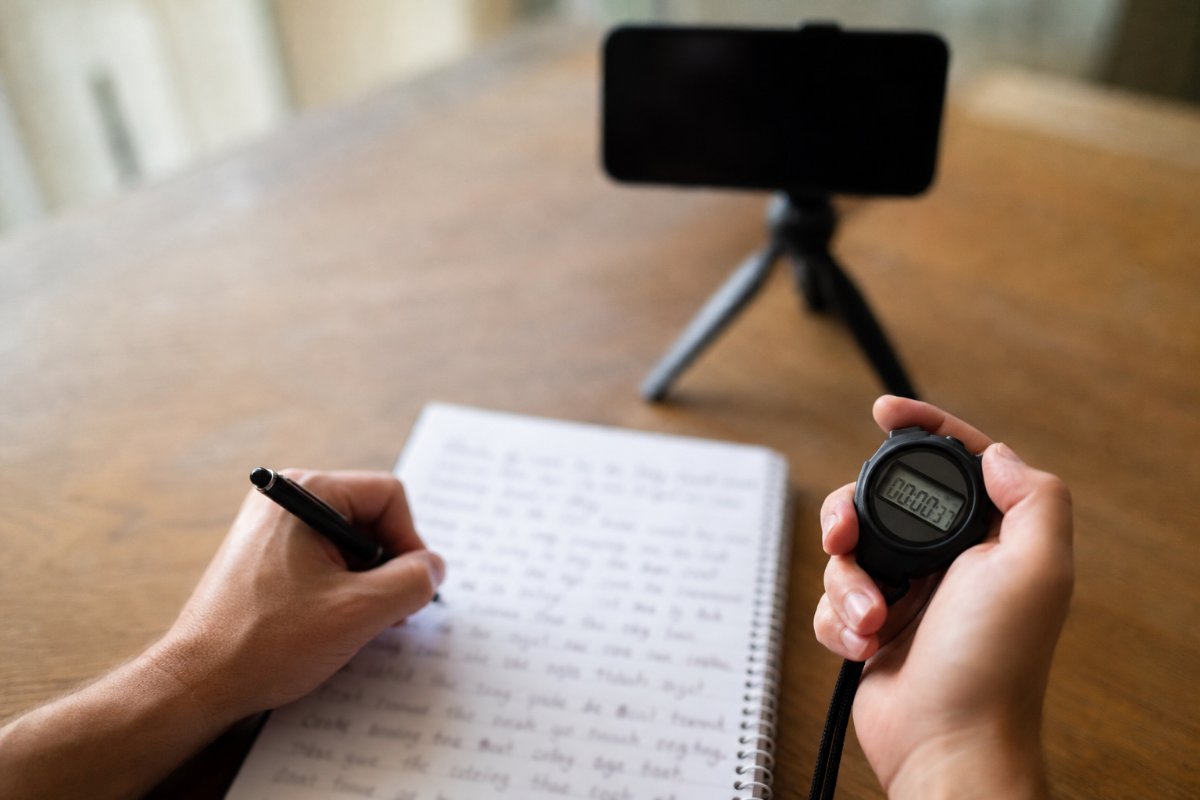
Most public guides land in the same place: around 60 to 80 words for 30 seconds and 130 to 160 words for 60 seconds, which assumes someone speaking English at roughly 130 to 160 words a minute. That's a useful starting point. It's not a rule.
Here's why. A 2019 study in Science Advances recorded speakers of 17 languages reading the same kinds of short texts. Speech rate, measured in syllables per second, varied a lot between languages. What stayed similar was the amount of information per second, at roughly 39 bits (Coupé et al., Science Advances, 2019). Languages that pack less meaning into each syllable are spoken faster, and denser ones slower.
What that means for you: a word count written for English doesn't tell you how long your Urdu, Hindi, Arabic or Bahasa script will run. Urdu also joins words differently from English, so even counting "words" is fuzzy. We didn't find a reliable published words-per-minute figure for Urdu or Hindi, so we won't give you one.
Do this instead. It takes two minutes:
- Open your phone's voice recorder.
- Talk about your niche for 60 seconds the way you would on camera. Not reading. Talking.
- Play it back and count the words. That's your personal 60 second budget.
- Halve it for 30 seconds, then take off a few words, because the hook and CTA need breathing room.
If you mix Urdu and English in the same sentence, like most of Pakistani TikTok does, count the mixed version. That's the one you'll actually say.
Beat by beat: what each part owes the viewer
Hook (0 to 3 seconds)
TikTok's own creative guidance for advertisers says to get your core point in within the first 3 seconds and land the hook within the first 6 (TikTok creative best practices, read 12 Nov 2026). That page is written for ads, but the logic is the same for organic posts: people decide fast.
A good hook does one of three things. It names a problem the viewer has right now ("Your indoor videos look dark"). It promises a specific result ("Three changes, same phone, brighter video"). Or it contradicts something they believe ("It's not your phone").
Write the hook last. Seriously. Once you know what the payoff is, the hook is usually a short version of it.
If you want hook lines in Urdu or Roman Urdu, we wrote a whole page of them: TikTok hooks in Urdu.
Setup (3 to 10 seconds)
One or two sentences that tell the viewer what's coming and why they should stay. "I'll fix it in three moves, no new gear." That's it. No "hey guys, welcome back," no story about how you got here. The setup is a contract: here's what you'll get if you stay.
Body (10 to 45 seconds)
This is the value. Split it into points the viewer can count. Three is comfortable for 60 seconds. Two is enough for 30.
Each point should be one sentence of instruction and, if you have time, one sentence of why. Show it on screen while you say it. If you're filming a faceless video, the body is where your B-roll or screen recording does the work.
In a 60 second video, add a re-hook around the middle. One short line that resets attention: "The third one is the one nobody does." It costs you three seconds and keeps people from swiping at the point where most of them would.
Payoff (45 to 56 seconds)
The result. The before and after, the finished dish, the number going up, the answer to the question in the hook. If your hook made a promise, this is where you keep it, visibly.
The payoff is the most skipped beat in beginner scripts. People explain the tips and then jump straight to "follow for more." Show it working.
CTA (56 to 60 seconds)
One small ask, tied to the video. "Save this for your next shoot" works on a tutorial because people genuinely want to find it again. "Comment your city and I'll tell you the best time to film there" works if you'll actually reply. Pick one. Two asks get neither.
On-screen text has its own pace. TikTok's same guidance suggests around 5 to 10 words per second of text when you use it (TikTok creative best practices). So your CTA caption should be short enough to read before the video loops.
Worked example: the 30 second script
Topic: why indoor phone videos look dark. Faceless or talking head, both work.
Hook (0 to 2s, 13 words): "Your indoor videos look dark because of where you're standing, not your phone."
Setup (2 to 5s, 9 words): "I'll fix it in three moves, no new gear."
Body (5 to 22s, 41 words): "One: turn around so the window is in front of you, not behind you. Two: wipe the lens with your shirt. Fingerprints make everything look foggy. Three: tap your face on the screen and hold until the exposure locks, on most phones."
Payoff (22 to 28s, 8 words): "Same room, same phone. Look at the difference." (Cut to the before and after.)
CTA (28 to 30s, 6 words): "Save this for your next shoot."
Total: about 77 words. That's at the top of the range, which is fine because the payoff is mostly visual. If you speak slowly, cut "Fingerprints make everything look foggy" first. It's the least important sentence.
Notice what's missing. No greeting. No "in this video." No explaining why lighting matters in general. Every sentence either hooks, promises, teaches or proves.
The same idea at 60 seconds
Here's the trap: most people "extend" a 30 second script by making every part a bit longer. That gives you a slower version of the same video. Instead, keep the hook and setup almost the same and add two things: more depth in the body and a second payoff.
Hook (0 to 3s, 13 words): "Your indoor videos look dark because of where you're standing, not your phone."
Setup (3 to 10s, 18 words): "I'll fix it in four moves with no new gear, and the last one is the one nobody does."
Body (10 to 45s, 88 words): "One: turn around so the window is in front of you. Light behind you turns you into a shadow, because the phone exposes for the bright window. Two: wipe the lens with your shirt. A greasy lens makes even good light look foggy. Three: tap your face on the screen and hold until the exposure locks, on most phones. Now walking around won't make the picture jump. And four, the one nobody does: switch off the ceiling light. Overhead light puts shadows under your eyes. Window light alone looks softer."
Payoff (45 to 56s, 22 words): "Here's the before. Here's after the window. And here's after all four. Same room, same phone, about two minutes of changes." (Three quick cuts.)
CTA (56 to 60s, 10 words): "Save this, and comment your phone model if it still looks dark."
Total: about 151 words. Look at where the extra 74 words went. The hook didn't change. The setup gained a teaser for the fourth tip, which acts as a built-in re-hook. Each body point now has its "why" sentence. The payoff became three steps instead of one, so the viewer sees progress. And the CTA asks for something you can reply to, which gives you material for the next video.
Read both versions aloud with a timer. If the 60 second one runs to 70, cut words from the body, never from the payoff.
A Roman Urdu version of the template
Same structure, written the way people actually talk on Pakistani TikTok, with English words where they'd naturally be used. Swap in your own niche.
- Hook: "Aap ki indoor videos dark is liye nahin ke phone kharab hai. Masla jagah ka hai."
- Setup: "Teen cheezen badlein, koi naya saman nahin chahiye."
- Body: "Pehli: khirki ko apne saamne rakhein, peeche nahin. Doosri: lens ko kapre se saaf karein. Teesri: screen pe apne chehre ko tap karke hold karein, exposure lock ho jayega."
- Payoff: "Wohi kamra, wohi phone. Farq dekhein."
- CTA: "Isay save kar lein, agli shoot pe kaam aayega."
Time this version yourself rather than trusting the English word count. Mixed Urdu and English often runs at a different pace from either language alone, and that's exactly what the study above would predict.
If you'd rather start from a draft, Studio writes scripts at 15, 30, 60 or 180 seconds in Roman Urdu, Urdu script, Hindi, Arabic, Bahasa, English and a few more, using these same five beats with second timings. You still edit it into your own voice. A script that doesn't sound like you won't perform like you.
Where the idea should come from
A template solves the structure. It doesn't solve "what do I talk about." The cheapest way to get a good idea is to look at what already beat expectations in your niche and your country, then make your own version of the idea, not the video.
"Beat expectations" matters. A video with 2 million views on an account that always gets 2 million tells you nothing. A video with 400,000 views on an account that usually gets 30,000 tells you the idea or the format did something special. That ratio, views divided by the creator's usual views, is called an outlier multiplier. Discover shows it on every card with the formula and how fresh the number is, and you can filter by country and language so you're not copying ideas that only work in Texas.
Then do three things before you write:
- Open the video's breakdown and note the structure: what the hook was, where the payoff landed, how long the body ran. In Breakoutly that's the "Why it worked" panel, with the transcript and the hook quoted with its timestamp.
- Write down the one thing you'd change: your angle, your city, your experience, your language.
- Keep the source in Saved so you can check you didn't drift into copying it.
The structure is free to learn from. The words, footage and voice belong to the creator. TikTok's guidelines also keep reused content without anything new out of the For You feed, and we covered that in detail separately. Keep your script's words yours.
If a creator keeps producing outliers you learn from, follow their next posts in Tracking instead of searching for them every week.
30 or 60 seconds: how to choose
Pick 30 seconds when:
- You have one tip and one proof. Stretching it to 60 makes it slower, not better.
- You're testing a new hook or a new format. Short videos are cheaper to make and you learn faster.
- Your niche is entertainment, reactions or quick before and afters.
Pick 60 seconds when:
- The idea has steps that genuinely need explaining, like a recipe, a tutorial, a story with a turn in it.
- You have a second payoff. If you can't name the second payoff, you don't have a 60 second video yet.
- The 30 second version did well and people asked questions in the comments. The 60 second version answers them.
A note on longer videos and money. A video over one minute is a length, not a payout. Programs like Creator Rewards have their own rules on country, account and originality, and we went through what that means for creators in Pakistan in this guide to Creator Rewards. Don't stretch a 30 second idea to 61 seconds for a program you may not be in. Viewers can tell, and they swipe.
Mistakes that make a script sound read
Writing for the eye. Long sentences with commas look fine on paper and sound like a news anchor. Read every line aloud. If you take a breath in the middle, split it.
Opening with your name. Nobody new knows who you are yet, and they don't care until you've helped them. Put your name in your bio.
Three CTAs. "Like, comment, follow and check my bio" is four asks and zero results.
Memorising it word for word. Most people sound better with the hook and the CTA memorised exactly and the body as bullet points. You'll say the body slightly differently each take, which sounds natural.
No visual plan. A script is half the video. Next to each beat, write one line of what's on screen. If two beats have the same shot, the video will feel longer than it is.
Never checking the timer. Read it aloud, time it, cut it. Every script gets shorter on the second pass.
FAQ
How many words is a 60 second TikTok script?
About 130 to 160 words if you speak English at a normal pace, according to most public script guides. It changes with your language and your speed, so record yourself talking about your niche for one minute and count the words. That count is your real budget. For Urdu, Hindi or a mix, always time it rather than trusting an English word count.
How many words is a 30 second TikTok script?
Roughly 60 to 80 words in English. Use the same five beats as a 60 second video, hook, setup, body, payoff and call to action, at about half the time each. Keep the hook just as strong and the body to two points. If your draft runs over 30 seconds, cut from the body first and keep the payoff.
What is the best structure for a TikTok script?
Hook, setup, body, payoff, call to action. The hook stops the scroll in the first few seconds, the setup says what the viewer will get, the body delivers it in countable points, the payoff shows the result, and the call to action asks for one specific thing. Most scripts that feel weak are missing the payoff, not the hook.
Should I read my TikTok script or memorise it?
Memorise the hook and the call to action exactly, because those are the lines that need to land word for word. Keep the body as short bullet points and say it in your own words. You'll sound like you're talking, not reading, and you can do more takes without stumbling over a sentence you half remember.
Can I write my TikTok script in Roman Urdu?
Yes. Write it the way you'd actually say it, including English words you'd naturally use. The structure stays the same: hook, setup, body, payoff and call to action. The only thing that changes is timing, so read the Roman Urdu version aloud with a timer, because it won't match English word counts.
By Breakoutly Research
Breakoutly researches short-form video for creators outside the US. Every article cites its sources and is checked by a person before it goes live.